The Great Migration follows rain and grazing rather than a fixed calendar. The Mara Conservancy's migration FAQ describes a usual June–July start continuing into November and emphasizes that river crossings are difficult to predict. For a 2026 or 2027 booking, choose a suitable base and allow time rather than purchasing a promised crossing date.
This guide covers where the herds tend to be through the year, how to choose between the reserve, the Mara Triangle and the private conservancies, what the current entry fees look like, and the entry paperwork to sort out before you fly.
How the migration works
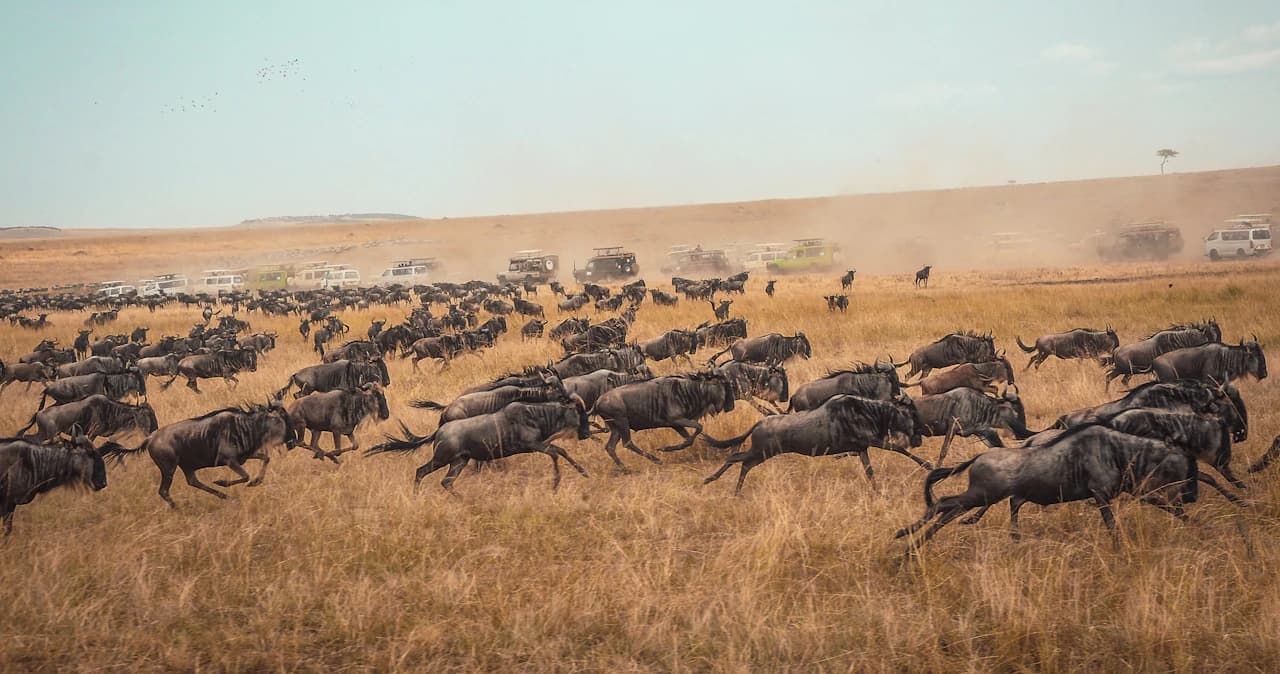
The migration is a continuous loop of wildebeest, with zebra and gazelle, through the Serengeti–Mara ecosystem shared by Tanzania and Kenya. The herds follow fresh grazing, which follows rainfall. Most of the year they are in Tanzania; the Masai Mara is the northern end of the circuit, reached in the dry season when the Serengeti's grass runs short.
Two points matter for planning:
- There is no fixed schedule. Safari publishers describe the same broad pattern each year, but early or late rains can shift arrival in the Mara by weeks. Asilia, which runs camps on both sides of the border, notes that rainfall is becoming less predictable.
- Crossings cannot be booked. Herds may gather on a riverbank for days and not cross, then cross several times in one day, in either direction. A longer stay improves your odds more than any particular date.
Where the herds usually are, month by month
The table below reflects the typical pattern described by established safari publishers. Treat it as a probability guide, not a forecast.
| Months | Usual location | Kenya side | What to expect |
|---|---|---|---|
| Jan–Mar | Southern Serengeti and Ndutu plains (Tanzania) | Herds absent; resident Mara wildlife remains | Calving, peaking around February, with heavy predator activity |
| Apr–May | Moving north through the central Serengeti | Long rains; some camps close; lowest prices | Slow northward movement, green landscapes, wet roads |
| Jun | Western Corridor and Grumeti area (Tanzania) | Herds still mostly south of the border | Rut and Grumeti River crossings, less predictable than the Mara |
| Jul | Northern Serengeti, first herds into the Mara | Arrival often from mid-to-late July, rain-dependent | Early crossings possible; the Mara starts to fill |
| Aug–Sep | Masai Mara and northern Serengeti | Peak period for Mara River crossings | Crossings in both directions; busiest and most expensive weeks |
| Oct | Herds drifting back south | Tail of the herds; southbound crossings | Fewer vehicles; crossings still possible early in the month |
| Nov–Dec | Movement south varies with rainfall | Confirm current herd locations with your camp | Resident wildlife remains; a month alone cannot establish where the herds are |
If you want to see the herds in Kenya, aim for late July to early October. For dates outside the usual Kenyan migration window, ask the operator about current herd locations and resident wildlife rather than assuming the same pattern every year.
Reserve, Mara Triangle or conservancy?
The Greater Mara is not one park. Where you stay shapes your experience as much as the month.
| Area | Managed by | What it suits | Trade-offs |
|---|---|---|---|
| Masai Mara National Reserve | Narok County | Direct access to the main Mara River crossing points | Daytime drives on tracks only; busy sightings in August and September |
| Mara Triangle (western reserve) | Mara Conservancy, a non-profit, under agreement | Crossing points on the western bank; tighter rules on vehicles | Separate ticket office and fee schedule; reached via Oloololo gate or Purungat bridge |
| Private conservancies (e.g. Mara North, Naboisho, Olare Motorogi) | Conservancy boards with Maasai landowners | Fewer vehicles, walking safaris, night drives, off-road sightings | Usually higher nightly rates; a 30–60 minute drive into the reserve for crossings |
A common approach in peak season is to split a stay: a few nights in or near the reserve for river access, then a few nights in a conservancy for quieter game viewing. Conservancy walking and night activities are generally not permitted inside the reserve itself.
Entry fees and ticket boundaries
Confirm your visitor category, accommodation location and entry route before paying. The Mara Conservancy's official fee instructions explain where Triangle visitors should pay, the identification needed for resident or citizen categories, and its cashless arrangements. A Triangle ticket should not be assumed to cover every reserve or conservancy activity.
Its published day ticket applies from 6am to 6pm, regardless of entry time, and does not roll into the following day. Ask your camp which fees are included, whether a departure-day drive needs another ticket and what happens if a tariff changes after booking. Read the current fee schedule for your category rather than budgeting from an old blog's dollar total.
Getting there and choosing your base
Most visitors fly into Nairobi's Jomo Kenyatta International Airport, then take a scheduled light aircraft from Wilson Airport to one of the Mara airstrips (around an hour), or drive (typically five to six hours depending on the gate and road conditions). Flying saves a day of travel and is common on peak-season itineraries; driving suits budget trips and those combining the Mara with Lake Nakuru or Lake Naivasha.
When picking a camp for crossings, ask the operator:
- How far the camp is from the main crossing points on the Mara River.
- Whether game drives can stay out all day with a packed lunch, since waiting at the river is often what pays off.
- How many vehicles typically gather at sightings, and whether the area applies vehicle limits.
- What happens if the herds are late or early — whether the itinerary can shift between areas.
Book peak-season camps well ahead. For August and September, many well-placed camps fill months in advance.
Responsible viewing at the river
Crossings attract dozens of vehicles at once. Stay behind the herds rather than blocking their approach to the bank, keep noise down, and let your guide follow reserve rules on distance and positioning. Choosing a conservancy camp also directs lease income to Maasai landowners, part of what keeps the dispersal areas around the reserve open to wildlife.
Entry to Kenya: the Kenya eTA
Most visitors need a Kenya Electronic Travel Authorisation (eTA) before travelling, though some nationalities are exempt. Check your nationality first, then review the Kenya eTA requirements; your safari itinerary and lodge confirmations will help with the accommodation details the form asks for.
For entry permission, use the official Kenya eTA portal and check current exemptions for your passport. Tourism bookings and entry permission are separate.
If you plan to add the Serengeti, Tanzania requires its own entry arrangements, separate from your Kenya eTA. The direct Sand River–Bologonja crossing between the two parks is not open to tourists, so trips usually connect by air or via an official border post such as Isebania–Sirari. Check whether your Kenya eTA covers your re-entry if you return to Kenya afterwards.
Sources and review
Checked 4 November 2026. Migration timing is a typical pattern, not a prediction. Current ticket rules were checked against the Mara Conservancy; obtain the current tariff from the relevant authority before paying.
- Mara Conservancy: migration timing and viewing rules
- Mara Triangle: conservation fees and ticket rules
- Governors' Camp: changes to Masai Mara park fees (2024 seasonal pricing and 12-hour rule)
- K24 Digital: a costlier Mara experience (August 2026 fee report)
- Asilia Africa: when to see the Great Migration
- Expert Africa: Serengeti wildebeest migration explained
- Africa Geographic: Mara conservancy or reserve?
- The EastAfrican: Serengeti–Mara border crossing remains closed
- Kenya eTA: official general information